
Our Model.
For YayGyiYar, the mental wellbeing-conflict transformation nexus is operationalised as interventions that simultaneously reduce trauma‑related symptoms and strengthen capacities for rebuilding relationships and social cohesion. We design programs to shift the underlying dynamics — attitudes, communication patterns, the willingness to engage with those perceived as ‘other’ — to improve the wellbeing of individuals and communities.
Evidence from other conflict contexts reinforces this approach. In Colombia, community-based psychosocial programmes running alongside the peace process were shown to increase meaningful civic participation among conflict-affected populations. In South Africa, the Truth and Reconciliation Commission drew on psychological frameworks as a mechanism for rebuilding social trust to make democratic governance viable. In Guatemala, indigenous Mayan communities that engaged in collective wellbeing practices demonstrated stronger, more durable engagement in local governance.
The lesson across these contexts is that long-term governance is relational, and the inner work of wellbeing and conflict transformation is at the heart of it.
Filling the gap.
The wellbeing-conflict transformation nexus appears in many overlapping spaces.
- Community groups and associations where people share their experiences, offer each other support, and then co‑design local ways of staying safe, reducing tension, and protecting each other in conflict settings.
- Conflict transformation-oriented psychosocial programmes where mental health and psychosocial support (MHPSS) are woven into community activities that help people handle stress, rebuild trust, and shift how they communicate during and after violence.
- Organisational and advocacy spaces where YayGyiYar links mental‑wellbeing and psychosocial work, so that these services are part of responses to conflict rather than separate from them.
- Everyday relational spaces – families, neighbourhoods, and informal learning settings – where people practice new ways of relating after trauma‑informed discussions, group support, or community‑based psychosocial sessions.
Our Interventions.
Our interventions are part of three pillars – networks, safer spaces, and research – that actively support both mental wellbeing and conflict‑transformation.
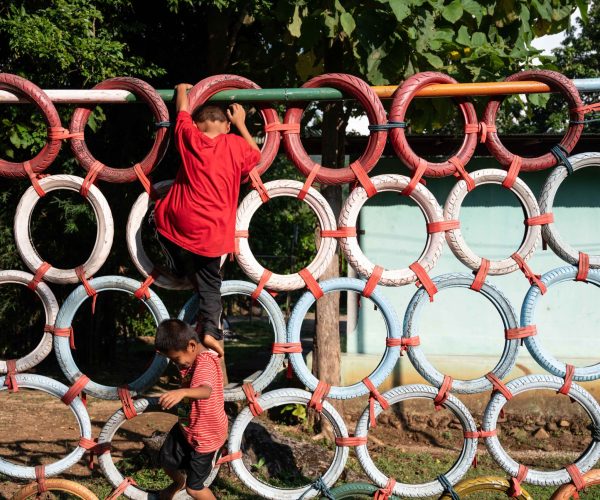
Photo credit: Miri Hauertmann
Pillar 1. Building Networks & Practice: YayGyiYar connects organisations, practitioners, and communities. This work aims to amplify reach, build collective capacity, create sustained systemic change, and advance integrated approaches across diverse contexts.
Pillar 2. Safer Spaces for Individuals, Groups: This work has a dual focus on mental wellbeing and relational repair offered through trauma‑informed therapeutic spaces for individuals and groups. Mental health therapeutic, somatic interventions and body-centred services are co-created and delivered both directly and through network partners, enabling broader reach and sustained local capacity.
Pillar 3. Research & Knowledge Building: Research, advocacy, and methodology development documenting the nexus of mental wellbeing and conflict transformation within communities. Knowledge is co-created with partners and disseminated through networks.
Conflict Sensitivity and Do No Harm.
YayGyiYar works in contexts affected by conflict and violence. We are committed to ensuring that our work does not increase risks, deepen divisions, or unintentionally cause harm.
We prioritise the safety and well-being of participants, partners, and staff in everything we do. This means carefully assessing risks, protecting sensitive information, and adapting our activities when needed.
We design our programmes to be inclusive and conflict-sensitive, making sure we do not reinforce inequalities or tensions. We also monitor our work closely to identify and address any unintended negative impacts. Do No Harm is an ongoing commitment. We listen, learn, and adapt to ensure our work supports communities in a safe and responsible way.
Our People: Wellbeing of Staff and Volunteers.
YayGyiYar recognises that we cannot support the wellbeing of others without ensuring the wellbeing of our own staff and network. Many of our team members operate in high-stress, trauma-affected contexts, and we acknowledge the risks of burnout, vicarious trauma, and secondary stress.
Wellbeing and safety are integral to our organisational approach. We embed these considerations across all areas of work by:
Photo credit: Moe
- Integrating wellbeing, workload, and risk considerations into programme design and planning
- Promoting a culture of open communication, peer support, and regular check-ins
- Encouraging sustainable working practices, including clear boundaries and adequate rest
Providing access to wellbeing and psychosocial support where possible - Implementing appropriate safety and security measures for staff and volunteers
We regularly review and adapt these practices to ensure a safe, supportive, and sustainable working environment.Wellbeing and safety are integral to our organisational approach. We embed these considerations across all areas of work by:
We believe that when individuals have resilient mental health within culturally-grounded support systems, they become sources of help for others to recover. This creates expanding circles of wellness that transform communities and contribute to positive peace.