

“Working with refugees and individuals affected by conflict has shown us how deeply the body carries the imprints of what people have lived through. In contexts of war, displacement, and prolonged uncertainty, survival often requires disconnecting from sensations and emotions that are too intense to process. Over time, this protective response can lead to numbness, fragmentation, or a loss of connection with one’s own physical presence, as if the body no longer feels like home.
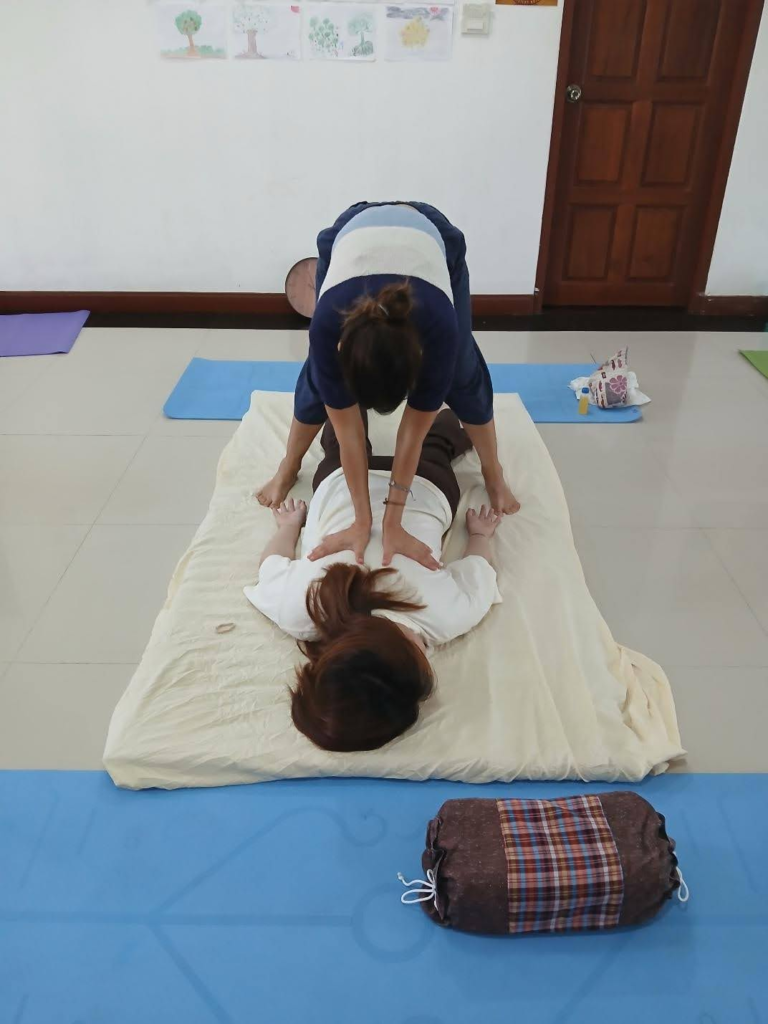
Massage and somatic practices offer a gentle way to begin returning home to oneself. Through attentive touch, mindful movement, and breath awareness, participants can start to feel the outlines of their bodies again, recognize sensations that had been muted, and find small moments of ease. These experiences provide a rare opportunity for many refugees to rest, receive care, and listen inwardly without fear.
Bessel van der Kolk, in The Body Keeps the Score, describes how trauma reshapes both the body and the brain, often trapping the nervous system in cycles of hypervigilance or shutdown. Recovery, he emphasizes, begins not with words but with the body’s capacity to feel safe again. Somatic work and mindful touch create the conditions for that safety, not through analysis but through presence, warmth, and embodied attention.
In the same way, Bonnie Bainbridge Cohen’s Body-Mind Centrering approach reminds us that the body itself holds intelligence and memory. By awakening interception, the capacity to sense what is happening inside; individuals can rediscover their innate resources for self-regulation. A simple breath, the awareness of weight on the ground, or the warmth of a supportive hand can become gateways to reconnection.
During our programs, massage sessions were not simply treatments but moments of deep listening. Many participants had spent years focusing outward, documenting suffering and advocating for others, rarely pausing to ask what their own bodies were holding. Through touch, they could rediscover their own boundaries, notice where they were holding tension, and perhaps feel the simple truth of “I am here.”
This reconnection is not about erasing pain; it is about making space for it without being consumed by it. As van der Kolk notes, the body must feel safe enough to relax before it can begin to process trauma. Gentle somatic work helps reestablish that safety, not as a theory but as a lived experience.
Participants often described leaving their sessions with a sense of stillness or quiet clarity. This is where change begins: not through forcing transformation but by cultivating the conditions where awareness can unfold naturally. As practitioners, our role is not to fix or interpret but to listen through touch, offering a relational field where each person can meet themselves with gentleness.
In this way, bodywork and somatic practices become subtle yet powerful tools for resilience, helping individuals reconnect with their sense of self, reclaim ownership of their bodies, and rediscover the possibility of presence even amidst uncertainty. “
